
From £20.95 ex. VAT.
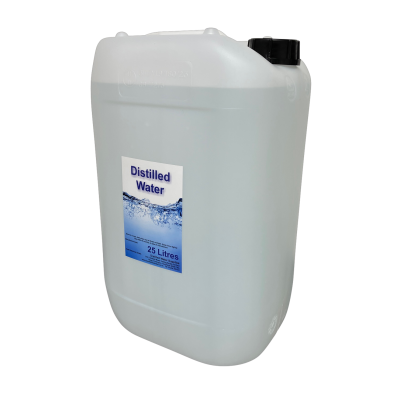
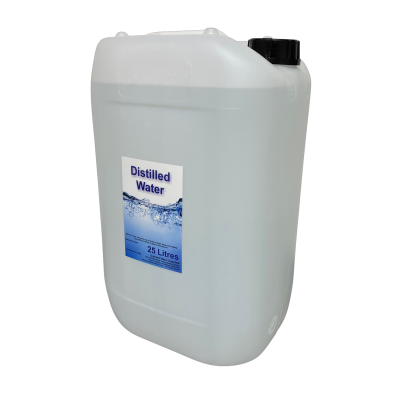
Our 25 litre Distilled Water drum is the most economical way to buy ultra pure distilled water from us. Perfect for jobs requiring large volumes such as research laboratories and industrial processes. The drum is made from food-grade HDPE and comes complete with a tamper-evident screw cap. For additional savings on larger orders, we can send the drums on a pallet to reduce packaging and delivery charges - Palletised delivery is available on quantities from 9 drums (see below).
Our 25 litre Distilled Water gives laboratories, workshops and regular home users the equivalent of five 5 litre bottles in one sealed drum. We produce it in the UK by steam distillation and check its conductivity and total dissolved solids daily. Its low mineral content makes it a useful choice for final glassware rinses and for equipment that specifies distilled water. Each new, food-grade drum has a tamper-evident screw cap. If you draw off small amounts regularly, a compatible dispensing tap is available separately. For larger orders, we offer volume discounts and pallet delivery from nine drums.
Our 25 litre Distilled Water drum holds the same amount as five of our 5 litre bottles. It suits a laboratory that rinses glassware daily, a workshop that refills equipment throughout the week or a household that gets through smaller bottles quickly. The main consideration when choosing between the two sizes is where you use the water. If everyone draws from one point, a single drum gives you one container to open and one water level to keep an eye on. If you carry water upstairs or share it between rooms, a 5 litre bottle is easier to handle. As a guide to how long a 25 litre Distilled Water drum will last, a workshop using five litres each working day will empty one in a week. At one litre per working day, the same drum will cover five working weeks.
We produce our 25 litre Distilled Water in the UK using a six-stage process that we have developed since we began distilling water in 2008. Preparation starts before the water reaches the still. A fine filter catches suspended particles, activated carbon reduces chlorine and an ion exchange stage removes much of the calcium and magnesium that give hard water its mineral content. The water then passes through a reverse osmosis membrane, which reduces the amount of dissolved material entering the still. We boil the prepared water in stainless steel equipment and cool the steam until it condenses back into liquid. Most dissolved salts stay behind in the still because they do not evaporate with the water. We circulate the distillate through a UV treatment system before bottling, and a final polishing stage uses ion exchange resin to capture traces of dissolved ions. Together, these steps give our 25 litre Distilled Water its low mineral content.
If you are choosing 25 litre Distilled Water for a particular piece of equipment, two useful figures to look for in the manual are conductivity and total dissolved solids. Conductivity describes how readily water carries an electrical current. Dissolved salts form charged particles called ions, so a low reading indicates that very few of these ions are present. Total dissolved solids, usually shortened to TDS, gives an indication of how much dissolved material the water contains. We check both figures daily and send samples to an independent laboratory for periodic analysis. Our water typically has a conductivity below 2 µS/cm and TDS below 1 mg/L. Our Water Specification page also gives individual results for substances including calcium, chloride and iron. If your method sets a limit for a particular mineral, you can look up that figure directly.
A final rinse of laboratory glassware is one example of where 25 litre Distilled Water can make a visible difference. When a beaker drains and the last droplets of hard tap water dry on the glass, the minerals they contain stay on the surface. A distilled water rinse after washing carries away the remaining tap water and leaves much less dissolved material behind as the glass dries. The same principle applies to a heated reservoir that regularly loses water as steam. Each refill with hard water brings in more calcium and magnesium, which can contribute to scale over time. If the equipment maker specifies distilled water for refilling, a drum beside the machine keeps the supply close at hand. In a workshop that mixes coolant from concentrate, the specified mixing ratio will also help you estimate how long a 25 litre Distilled Water drum will last.
Each 25 litre Distilled Water drum is made from new, food-grade high-density polyethylene, often abbreviated to HDPE. The screw cap has a tamper-evident seal that you can check when the drum arrives. The water alone weighs approximately 25 kg, so choose a stable dispensing point with enough room for the drum and a jug before you open it. If you regularly draw a litre or two at a time, our dispensing tap screws directly onto the drum and is available separately. Use a clean jug reserved for water, especially in a workshop where similar jugs may also be used for detergents or coolant. Even a small amount left in the bottom of a measuring jug will mix with the next fill. Pour out only what you need, keep the drum closed between uses and store it away from direct sunlight at 15–25°C.
For businesses ordering 25 litre Distilled Water in quantity, pallet delivery is available from nine drums. That gives you 225 litres in individually sealed containers, so you can open one drum at a time or allocate unopened stock to different departments. Twelve drums hold 300 litres and 24 drums hold 600 litres. The volume discount table shows the saving at each of those quantities. To compare order sizes, include delivery in the total and divide by the number of litres to find your delivered cost per litre. Your rate of use matters here too. A site using 50 litres a week will work through a 12-drum order in six weeks. That gives you a basis for planning the next delivery and deciding how much storage space to set aside. Each 25 litre Distilled Water drum carries an expiry date, so you can put the earliest-dated stock into use first.
How should I store the drum after opening it?
Keep it closed between uses and store it away from direct sunlight at 15–25°C. Use a clean jug or bottle when dispensing and pour out only what you need. Returning unused water to the drum can introduce residue from the receiving container.
Is the water steam distilled or just deionised or reverse osmosis?
We use all three processes to ensure maximum purity. Reverse osmosis prepares the feedwater before it enters our stainless steel still. We then boil the water, cool the steam and collect the condensed liquid. Dissolved salts largely stay behind in the still.
How many drums qualify for pallet delivery and volume discounts?
Pallet delivery is available from nine drums, which gives you 225 litres. The other volume discount quantities are 12 drums for 300 litres and 24 drums for 600 litres. Each drum is sealed individually, so you can open one at a time.
From £6.45 ex. VAT.
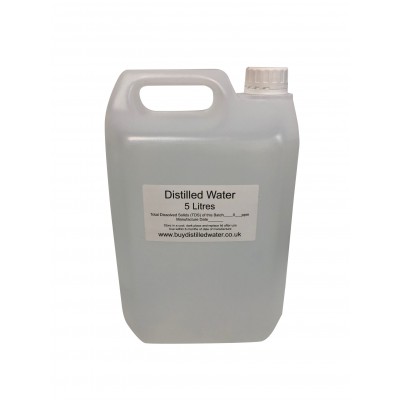
IN STOCK NOW! Our 5 litre Distilled Water drum is economical, yet easy to carry and pour. Our 5 litre bottles have an integral handle and are designed to be easy to transport and store. The larger size makes them perfect for larger applications, while still being light enough to carry.
Our 5 litre drum is the convenient, great‑value size for regular users who still want easy handling and storage. Every batch is steam‑distilled, polished through mixed‑bed resins and UV‑treated, then bottled in brand‑new, food‑grade HDPE with a tamper‑evident screw cap. We’ve specialised in distillation since 2008, with daily EC/TDS checks and periodic UKAS‑accredited lab analysis.
Each of our 5 litre distilled water bottles is equipped with a tamper-evident screw cap, making it easy to tell if the bottle has been opened. These food-grade HDPE containers are certified BPA-free.
Distilled water is the purest form of water available. Unlike filtered water, distilled water goes through a 6-stage process that removes impurities, sediment and minerals. As a result, it's far purer than any other type of water.
Ideal wherever low‑conductivity, mineral‑free water prevents deposits or interference:
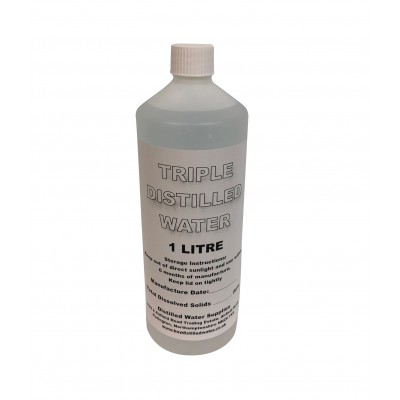
The latest addition to our range of waters. This triple distilled water is batch made in laboratory glassware for applications requiring the highest purity levels. Water is distilled on day of dispatch for maximum freshness.
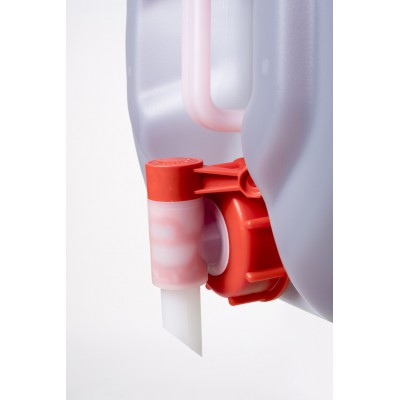
A robust and hard wearing dispensing tap that can be screwed directly on to our 25 litre drums for precise and accurate pouring.
IN STOCK NOW! Our 25 litre Distilled Water drum is the most economical way to buy ultra pure distilled water from us. Perfect for jobs requiring large volumes such as research laboratories and industrial processes. The drum is made from food-grade HDPE and comes complete with a tamper-evident screw cap. For additional savings on larger orders, we can send the drums on a pallet to reduce packaging and delivery charges.
Buy 25 litre drums of distilled water directly from the manufacturer. We use our own proprietary 6-step method to ensure our water is of the highest quality and it undergoes UV sterilisation prior to bottling to further reduce potential bacteria. Our water is 100% steam distilled, not just filtered, deionised, or reverse osmosis water. After you buy distilled water from us, keep the drum sealed and away from sunlight, storing it between 15-25°c.
Ordered for topping up serviceable batteries in our workshop. Delivered quickly, with every container securely sealed.
David
Bought for topping up my forklift’s battery.
Neil
Bought for the final rinse when cleaning precision components. Low mineral content matters for this particular job.
Stephen
From £6.45 ex. VAT.
IN STOCK NOW! Our 5 litre Distilled Water drum is economical, yet easy to carry and pour. Our 5 litre bottles have an integral handle and are designed to be easy to transport and store. The larger size makes them perfect for larger applications, while still being light enough to carry.
Our 5 litre drum is the convenient, great‑value size for regular users who still want easy handling and storage. Every batch is steam‑distilled, polished through mixed‑bed resins and UV‑treated, then bottled in brand‑new, food‑grade HDPE with a tamper‑evident screw cap. We’ve specialised in distillation since 2008, with daily EC/TDS checks and periodic UKAS‑accredited lab analysis.
Each of our 5 litre distilled water bottles is equipped with a tamper-evident screw cap, making it easy to tell if the bottle has been opened. These food-grade HDPE containers are certified BPA-free.
Distilled water is the purest form of water available. Unlike filtered water, distilled water goes through a 6-stage process that removes impurities, sediment and minerals. As a result, it's far purer than any other type of water.
Ideal wherever low‑conductivity, mineral‑free water prevents deposits or interference:
A robust and hard wearing dispensing tap that can be screwed directly on to our 25 litre drums for precise and accurate pouring.
IN STOCK NOW! Our 25 litre Distilled Water drum is the most economical way to buy ultra pure distilled water from us. Perfect for jobs requiring large volumes such as research laboratories and industrial processes. The drum is made from food-grade HDPE and comes complete with a tamper-evident screw cap. For additional savings on larger orders, we can send the drums on a pallet to reduce packaging and delivery charges.
Buy 25 litre drums of distilled water directly from the manufacturer. We use our own proprietary 6-step method to ensure our water is of the highest quality and it undergoes UV sterilisation prior to bottling to further reduce potential bacteria. Our water is 100% steam distilled, not just filtered, deionised, or reverse osmosis water. After you buy distilled water from us, keep the drum sealed and away from sunlight, storing it between 15-25°c.