How is Distilled Water different from Deionised Water?
How Is Distilled Water Different from Deionised Water?
Distilled water and deionised water are both forms of purified water, but they are not the same. They are made in different ways, they remove different types of impurities, and they are suited to different uses. Understanding these differences helps you choose the right water for your equipment, processes and day-to-day tasks.
At a glance, both types of water look identical. The real difference lies in what has been removed, what may still remain, and how predictable the water is in demanding environments such as laboratories, industry and medical settings.
What Is Distilled Water?
Distilled water is produced using heat. The process of distillation relies on changing water from liquid to vapour and back again.
Water is heated until it boils and turns into steam. Most dissolved solids, such as mineral salts and most metals, do not boil at this temperature. They are left behind in the boiling chamber as the steam rises. The steam is then cooled in a separate section of the equipment, where it condenses back into liquid water. This condensed liquid is collected as distilled water.
Because many impurities are left behind during boiling, distilled water is very low in dissolved minerals (TDS). It also removes a good proportion of many heavy metals and some microorganisms. The result is a clean, consistent and predictable water quality.
In some cases, water is distilled more than once (such as our triple distilled water) to achieve even higher levels of purity. It is used where extremely low levels of contamination are essential.
What Is Deionised Water?
Deionised water, sometimes written as de-ionised water or DI water, is produced using a much cheaper method. Instead of boiling, deionisation uses resins to remove charged particles from the water.
These resins are usually contained in columns or cartridges. As water passes through them, dissolved ions in the water are exchanged for hydrogen and hydroxide ions on the resin. The hydrogen and hydroxide then combine to form pure water, while the unwanted ions are held on the resin.
Deionisation is very effective at removing dissolved mineral ions, such as calcium, magnesium, sodium and chloride. As a result, deionised water can have very low conductivity and can be extremely low in total dissolved solids, especially when produced by high-quality systems and maintained correctly.
However, deionisation only targets charged particles. It is less effective at removing uncharged organic molecules, bacteria, viruses and dissolved gases. For this reason, deionised water may still contain substances that are not removed by the ion-exchange process.
The Key Differences in Purity
Distillation and deionisation both aim to purify water, but they focus on different groups of contaminants.
Distilled water is purified by vapourisation and condensation. This step removes most dissolved minerals and many non-volatile contaminants. It can also significantly reduce microorganisms.
Deionised water is purified by ion-exchange. This method is excellent at removing ions, which are charged particles. It can produce water with extremely low conductivity, which is useful in electrical and electronic applications. Nevertheless, deionisation does not specifically remove uncharged organic compounds or microorganisms.
In practice, distilled water tends to offer broader removal of many different kinds of impurities. Deionised water can reach very low ion levels, but its overall purity depends on the quality of upstream and downstream treatment.
How They Are Used in Practice
The choice between distilled and deionised water is often based on the level of purity required and cost-effectiveness.
Distilled water is commonly used where a consistent, low-mineral water is needed and where the presence of organic residues or microorganisms must be reduced. Typical uses include:
Autoclaves and sterilisers, Medical and dental equipment, Laboratory reagents and washing, Steam irons and garment steamers, CPAP machines and humidifiers, Lead-acid batteries and some cooling systems
Deionised water is often used where large volumes of purified water are needed without the energy cost of boiling. Common uses include:
Electronics manufacturing and circuit board rinsing, Industrial processes that require very low ion content, Some laboratory instruments and analytical systems, Automotive cooling and rinsing tasks, Mixing with additives where ionic contamination must be minimised
In some high-end systems, water may be both distilled and deionised, or treated with a combination of technologies, to meet very strict purity requirements.
Which Is Better: Distilled or Deionised?
There is no single answer that fits every situation. Instead, each type of water has its strengths.
Distilled water is generally preferred when:
You want a broad reduction in many types of contaminants. You need water that has been physically separated from its original impurities by vapourisation. You are using devices, such as autoclaves or steam-based equipment, that specify distilled water.
Deionised water is generally preferred when:
Low electrical conductivity is critical. You need large volumes of cheaper purified water on demand, often on-site. Your process already includes additional purification stages that complement deionisation.
For many everyday uses, such as topping up batteries, feeding steam irons or supplying humidifiers, either high-quality distilled water or high-quality deionised water may be acceptable, provided they meet the equipment manufacturer’s recommendations. For more sensitive applications, the specification of the device or process should always be followed carefully.
Both distilled and deionised water require suitable storage and handling to maintain their quality. Because they are low in dissolved minerals, they can slowly dissolve small amounts of material from containers, pipes and fittings. For this reason, they are usually stored in suitable plastic or glass vessels designed for purified water.
Containers should be kept closed when not in use to reduce contamination from dust, particles and gases in the air. Over time, contact with the atmosphere can increase the conductivity of purified water as it absorbs carbon dioxide and other substances.
From a safety perspective, both distilled and deionised water are simply purified forms of water. They are not inherently dangerous in normal use. However, they can behave differently from tap water in certain technical contexts, especially where electrical conductivity, corrosion or microbiological control are important.
Understanding how distilled water differs from deionised water, and how each one is produced, makes it easier to select the most appropriate type of purified water for your specific application, whether that is in a laboratory, an industrial setting, a medical environment or around the home.
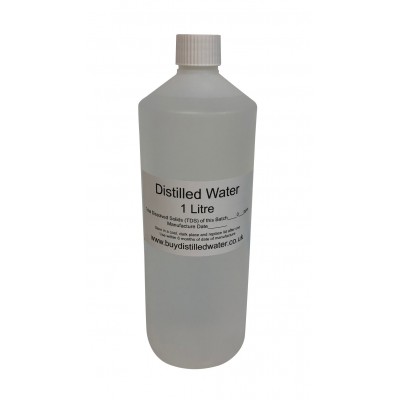
From £2.90 ex. VAT.
IN STOCK NOW! This handy 1 Litre bottle size is perfect for regular home users as well as 'one-off' research and testing purposes.
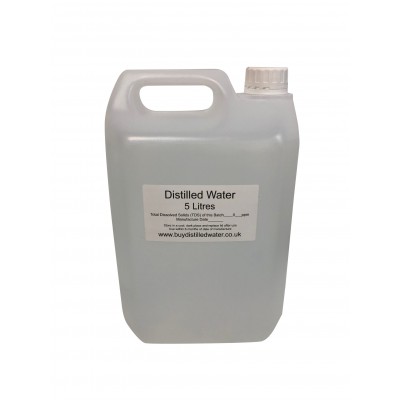
Pure, Distilled Water - Now Available in 5 Litre Containers
From £6.45 ex. VAT.
IN STOCK NOW! Our 5 litre Distilled Water drum is economical, yet easy to carry and pour. Our 5 litre bottles have an integral handle and are designed to be easy to transport and store. The larger size makes them perfect for larger applications, while still being light enough to carry.
Our 5 litre drum is the convenient, great‑value size for regular users who still want easy handling and storage. Every batch is steam‑distilled, polished through mixed‑bed resins and UV‑treated, then bottled in brand‑new, food‑grade HDPE with a tamper‑evident screw cap. We’ve specialised in distillation since 2008, with daily EC/TDS checks and periodic UKAS‑accredited lab analysis.
Each of our 5 litre distilled water bottles is equipped with a tamper-evident screw cap, making it easy to tell if the bottle has been opened. These food-grade HDPE containers are certified BPA-free.
Distilled water is the purest form of water available. Unlike filtered water, distilled water goes through a 6-stage process that removes impurities, sediment and minerals. As a result, it's far purer than any other type of water.
Uses & applications
Ideal wherever low‑conductivity, mineral‑free water prevents deposits or interference:
- CPAP machines and home humidifiers
- Steam irons and garment steamers
- Lead‑acid car batteries and coolant top‑ups
- Autoclaves, sterilisers and lab glassware rinsing
- Cosmetics blending and printing/photography
- Optics and electronics cleaning/setup
- Houseplants (e.g., orchids, carnivorous plants)
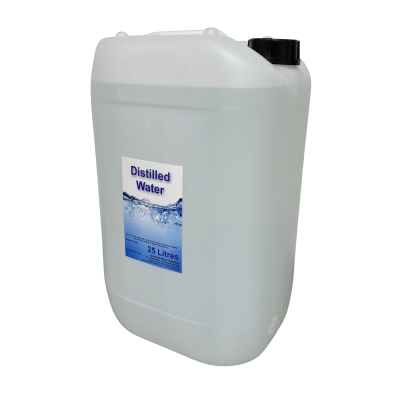
From £20.95 ex. VAT.
IN STOCK NOW! Our 25 litre Distilled Water drum is the most economical way to buy ultra pure distilled water from us. Perfect for jobs requiring large volumes such as research laboratories and industrial processes. The drum is made from food-grade HDPE and comes complete with a tamper-evident screw cap. For additional savings on larger orders, we can send the drums on a pallet to reduce packaging and delivery charges - Palletised delivery is available on quantities from 9 drums (see below).
Buy 25 litre drums of distilled water directly from the manufacturer. We use our own proprietary 6-step method to ensure our water is of the highest quality and it undergoes UV sterilisation prior to bottling to further reduce potential bacteria. Our water is 100% steam distilled, not just filtered, deionised, or reverse osmosis water. After you buy distilled water from us, keep the drum sealed and away from sunlight, storing it between 15-25°c.