How Pure is Distilled Water?
Distilled Water is often described as 'pure', but purity is not a single fixed number. It is a practical idea that depends on what you want removed and how you measure what remains. In simple terms, Distilled Water is made by turning water into steam and then condensing that steam back into liquid, which leaves nearly all dissolved minerals behind. That is why it is associated with 'no limescale' uses and with technical settings where mineral residue matters. At the same time, 'pure' can mean low minerals, low organic compounds, low microbes, or low particles, and a product can be excellent in one sense while only moderate in another. A realistic view is that Distilled Water is highly purified water, but its exact purity is defined by process controls, testing, and how it is stored after production.
Distillation works because many impurities do not evaporate at water’s boiling point. Salts, calcium and magnesium compounds, and most metals remain in the boiling chamber, while the vapour that leaves the surface is predominantly water. When that vapour is cooled, it becomes Distilled Water with a much lower mineral load than tap water. The effectiveness is influenced by design. A system that minimises splashing and has proper vapour separation reduces the risk of tiny droplets of feed water being carried over, which would reintroduce minerals. Some systems (ours included) include baffles, and we s control temperature, flow, and cleaning cycles to keep performance stable. A single distillation step typically produces Distilled Water suitable for appliances and general use, while our triple distillation process is used when lower ionic content is required.
The areas where Distilled Water can be less 'absolute' than people expect are mainly volatile substances and post‑process contamination. Certain organic compounds can evaporate with steam or have boiling points close to water, so they are not automatically excluded by simple distillation. Dissolved gases also travel easily; even perfectly distilled vapour can carry carbon dioxide or other gases that later dissolve in the condensed water. For that reason, we adds steps such as pre‑filtration, activated carbon treatment, controlled venting of early vapour. Another subtle route is mechanical carryover: if a still is boiling too vigorously or is contaminated with foam‑forming residues, microscopic droplets can be entrained in the vapour stream. Good engineering reduces this risk, but it explains why two bottles both labelled Distilled Water can perform differently in sensitive equipment.
Purity is best understood through measurements. For mineral and salt content, electrical conductivity is widely used because dissolved ions conduct electricity. Lower conductivity generally indicates fewer ions, while higher readings suggest more dissolved salts. Distilled Water often has low conductivity compared with tap water, but it can rise after bottling or opening because low‑mineral water absorbs carbon dioxide from air and forms weak carbonic acid, which produces ions. Resistivity is another way of expressing the same behaviour, with higher resistivity indicating fewer ions. Total dissolved solids (TDS) meters estimate mineral content, but they do not detect every type of contaminant, especially non‑ionic organics. For organic purity, manufacturers may use tests such as total organic carbon, while particle counts and turbidity address physical cleanliness. pH is frequently misunderstood for very pure water; because the ionic content is so low, pH readings can be unstable and easily influenced by atmospheric gases. A trustworthy view of Distilled Water purity relies on the right metric for the risk you care about, not a single headline claim.
Microbiological purity is a separate dimension. Distilled Water is not automatically sterile, because even if the distillation step involves heat, the condensed water can pick up microbes from the condenser, storage tank, air exposure, or the container itself. Once present, microbes may not multiply rapidly in low‑nutrient water, but they can persist, and biofilms can develop in poorly maintained systems. This matters most for applications that are sensitive to microbial contamination, such as certain laboratory procedures, medical devices with strict requirements, or any use where a manufacturer specifies sterile water rather than Distilled Water. We mitigate this by our use of a final UV sterilisation step prior to bottling.
Storage and handling play a large part in maintaining consistency. A sealed container limits gas absorption and airborne contamination. Clean dispensing reduces the chance of introducing minerals from taps, spoons, or funnels. Container materials also matter: some packaging can contribute trace leachables over time, and higher temperatures can accelerate that process. These are usually trace‑level effects, but they become relevant when the equipment or process is highly sensitive. We only ever us BPA-free food grade containers to minimise this.
It also helps to place Distilled Water alongside other purification terms so purity statements are interpreted correctly. Deionised water is produced with ion‑exchange resins that remove charged ions very effectively, but it will leave non‑ionic organics. Reverse osmosis relies on a membrane that reduces many dissolved substances, but performance depends on membrane condition, pressure, and feed water quality.
What does distillation remove from water?
Distillation removes most dissolved minerals and salts that cause hardness and residue, and it greatly reduces many metals and particulates. The water is vaporised and condensed, leaving non-volatile substances behind. The result is Distilled Water that typically dries with minimal spotting and scale compared with mains water.
Is Distilled Water the same as deionised water?
No. Distilled Water is made by evaporation and condensation, while deionised water is produced by ion-exchange resins that remove charged ions. Both can be low in minerals, but they behave differently for organics and microbes, and they may have different specifications depending on the process and intended use.
Does Distilled Water remove chlorine and limescale?
Distillation removes limescale-forming minerals because they do not evaporate with steam. Chlorine behaviour depends on conditions, as some chlorine-related compounds can volatilise, but we use carbon filters to remove chlorine prior to distillation.
How is the purity of Distilled Water tested?
Purity is often checked with conductivity or resistivity, which indicate ionic content, and with total dissolved solids measurements. Depending on grade, testing can also include particulates, specific metals, or organic content. For critical uses, batch records or stated compliance with a specification are common.
What container is best for storing Distilled Water?
Clean, sealed, food-grade plastic or suitable glass is typically used to store Distilled Water. Containers should be dedicated to this purpose and kept away from heat and strong odours. Avoid reactive metals and poorly made plastics, as they can add trace ions or unwanted compounds over time.
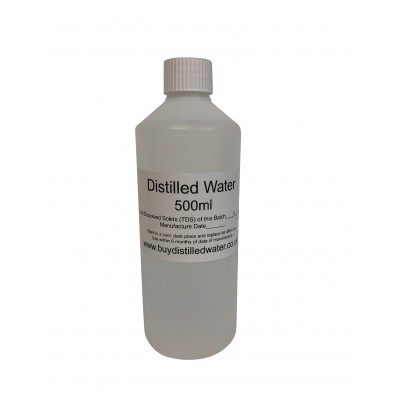
IN STOCK NOW! Our 500ml bottle of Distilled Water - Perfect for use at home in steam irons, humidifiers, steam generators etc.
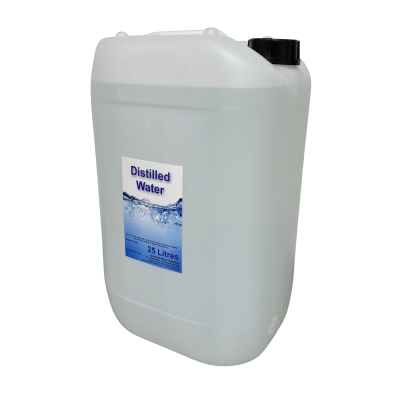
From £20.95 ex. VAT.
IN STOCK NOW! Our 25 litre Distilled Water drum is the most economical way to buy ultra pure distilled water from us. Perfect for jobs requiring large volumes such as research laboratories and industrial processes. The drum is made from food-grade HDPE and comes complete with a tamper-evident screw cap. For additional savings on larger orders, we can send the drums on a pallet to reduce packaging and delivery charges - Palletised delivery is available on quantities from 9 drums (see below).
Buy 25 litre drums of distilled water directly from the manufacturer. We use our own proprietary 6-step method to ensure our water is of the highest quality and it undergoes UV sterilisation prior to bottling to further reduce potential bacteria. Our water is 100% steam distilled, not just filtered, deionised, or reverse osmosis water. After you buy distilled water from us, keep the drum sealed and away from sunlight, storing it between 15-25°c.
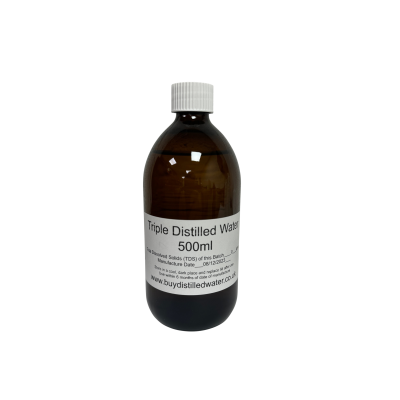
IN STOCK NOW! 500ml bottles of our triple distilled water - Perfect for use at home for applications requiring ultra pure distilled water that has undergone distillation three times.
Triple Distilled Water improves on the purity of our regular distilled water. By undergoing the distillation process three times, each cycle further refines and purifies the water, ensuring that any remaining impurities are meticulously removed. Our triple process guarantees a level of purity that is unparalleled, making it an ideal choice for a variety of uses such as making colloidal silver and homemade cosmetics and soaps, ensuring that the final products are free from any impurities that could irritate the skin.